About Internal Contracting for Global Service
Internal Contracting for Global Service enables service organizations across different IFS Companies to operate as a coordinated global service provider while maintaining correct financial separation, accountability, and operational control. It allows one company to own the customer relationship and revenue, while another company performs the work within its own organizational and financial context. The capability extends the contractor management foundation within IFS Cloud to support structured, auditable collaboration between internal service entities.
Purpose and Business Value
This capability supports global service operations by enabling companies to share resources, balance capacity, and execute work across regional boundaries without relying on manual agreements or off‑system reconciliation. It ensures accurate intercompany financials, preserves the integrity of company‑level cost and revenue, and provides technicians with a consistent experience even when working across multiple companies or service organizations.
Example Use Cases
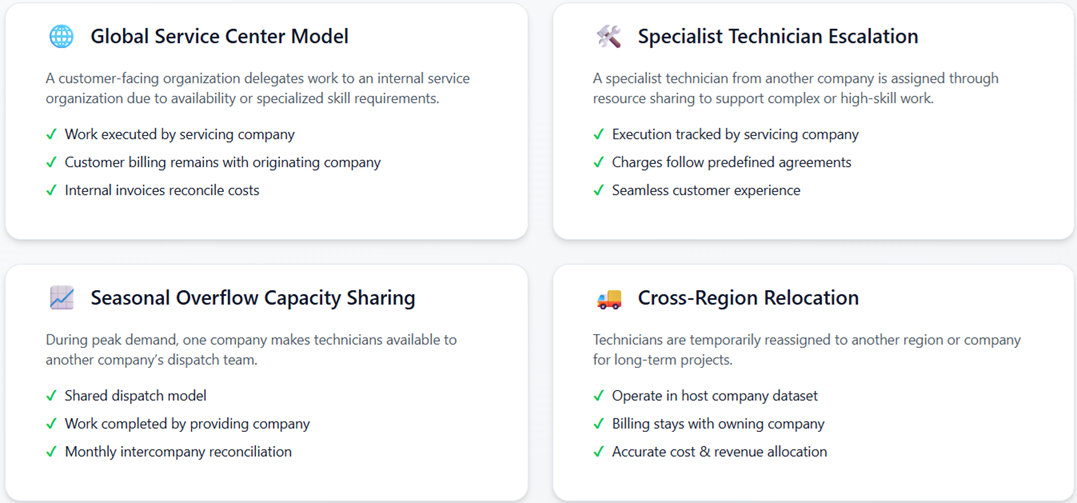
Internal Contracting Setup
To faciliate the use of internal contracting between IFS Companies the following data objets should be created and/ or considered:
Internal IFS Company as a Service Contractor: Internal contracting between IFS relies on the company that is sharing resource or executing the work on behalf of another to be set up as an Intercomapny Contractor in IFS Cloud. To do this, ensure that when creating a Service Contractor that the Contractor Scope is set to Intercompany (Internal) and an IFS Company has been selected. This will facilitate the flow of work, resource, and invoices between the two companies.
Internal Contractor Agreements Between Company: Internal Contracting makes use of defined contractor agreements between IFS Companies. These agreements specify how work executed by one company on behalf of another is valued and charged for in the same was as an external contractor agreement.
To define a Contractor Agreement between IFS Companies, the Agreement Scope of Intercompany should be selected when creating the contractor agreement along with the applicable Company.
Internal Contractor Orders Between Companies: To facilitate the flow of work between IFS Companies, Contractor Orders of Scope Intercompany will be utilized and this will be set automatically depending on the contractor being used for the work, i.e., internal or external.
Note: Service Contractors, Agreements, and Orders of scope External refers to a service provider company to service contractor relationship.
Resource and Capacity Sharing Across Companies
Service organizations can request support from other internal service entities, enabling shared capacity across IFS Companies. Technicians remain employed and scheduled primarily in their home company but may:
- Appear in another company’s scheduling dataset
- Receive assignments from multiple service organizations
- Execute work under the terms of the internal contractor agreement
To share resources as part of an Intercompany Contractor Order, select the Relocate command on the Contractor Order page. This command is only available where the scope of the Order is Intercompany. The Resource Relocation assistant can then be used to define the relocation arrangements for the resource from their home company to their host company. As part of the relocation definition, specific company information relating to the host company can be defined such as:
- Company Name
- Site
- Resource Group
- Mobile User
Once saved, the relocation will be linked to the Intercompany Order and upon activation of the resource relocation the specific company host information will be added to the resource record. For exmaple, Sally Smith, who only usually works in Company A is being assigned to work for Company B next week as part of a resource sharing initiative. As part of the relocation it was defined that she was to be set up as an MWO User in Company B with specific site access and will be working as part of a particular resource group. When the relocation is activated, her resource connections are updated along with her site/company access and MWO usage for the new company.
If the relocation or the order is subsequently cancelled, then the data is rolled back.
Relocations that are linked to an Intercompany order can only be activated when the Order has been Accepted.
Mobile Work Order Support Across Companies
Technicians working with Mobile Work Order can be connected to multiple companies and service organizations. They can accept and execute assignments regardless of the owning company. The system ensures that:
- Part issues and returns occur in the correct company’s inventory
- Time and expenses are posted to the executing company
- Safety and procedural controls align with the correct organizational context
A customer contract, service request, or work order may be owned by Company A while executed by Company B. All operational reporting—time, travel, expenses, and material consumption—occurs in Company B’s context. Technicians working on tasks linked to intercompany orders will be able to conduct all operational reporting through the MWO device in the usual manner.
Intercompany Transactions and Internal Invoicing
Actuals reported by the executing company are set to 0 on the Work Task Transaction and are handled through the generation of intercompany transactions (payment lines) based on the agreed internal company-to-company rates.