About Change Request
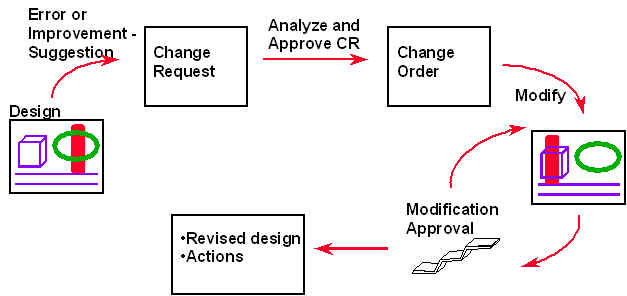
Change Requests (CRs) are formal records primarily used to capture, evaluate, and manage changes related to engineering parts and processes. CRs help analyze the consequences of proposed engineering changes, such as error corrections or improvements, and serve as the foundation for creating Change Orders (COs) that authorize work.
Status Definitions
Each Change Request moves through a series of statuses that reflect its stage in the engineering change management process:
- Preliminary — The CR is being prepared. Analysis of consequences, costs, and registration of information is not yet complete. This is the default status when a CR is created.
- Active — The CR is ready and awaiting the issuance of a CO. The CR cannot be set to Active until all required approvals are completed.
- Processed — A CO has been issued for this CR. When the CO is approved, the status of all connected CRs automatically changes to Processed.
- Canceled — The CR is rejected or no longer needed, and no CO will be issued. Canceled CRs may later be classified as postponed or deleted requirements.
Change Request Handling Process
The process of handling Change Requests focuses on engineering requirements and part changes, and involves several key steps:
- Evaluate and register engineering requirements that may lead to CRs.
- Qualify requirements by discarding, postponing, or registering them as CRs.
- Establish approval routing for each CR, identifying the individuals who must approve before further action.
- Perform a preliminary change study to assess the impact of each CR.
- Prioritize CRs by deciding which to fulfill (by connecting to a CO) and which to cancel.
- Update the status of each CR as it progresses through the process.
Prerequisites and System Effects
- A CR must exist before its status can be updated.
- If approval routing is defined, all approvals must be completed before changing a CR from Preliminary to Active.