About Project Pre-posting
Project Pre-posting is a feature used to control how expenses are posted during the execution of a project. The purpose is to define a default code string where all required code parts are specified in IFS/Accounting Rules. This code string is then used in IFS Financials to pre-post project-related transactions.
Pre-posting is defined on the Pre Postings tab in Project Setup and can be specified at both the project and sub project levels. If the same code string should apply to all sub projects under a project, enter an asterisk (*) in the Sub Project field. You can also create a hierarchy where a sub project overrides the project’s code string with its own.
Before defining pre-posting, companies and any required alternative code parts must be registered in IFS Financials. After this setup, you can enter values for each code part to build the code string used for pre-posting at the project or sub project level. All objects connected to a project will use this project-specific code string information.
When a project activity is manually connected to an object, any existing pre-posting on that object is replaced with the project pre-posting values. If the project pre-posting does not include a value for a particular code part, the object’s existing pre-posting value remains unchanged.
If the project connection occurs automatically, the child object inherits the parent object’s pre-posting values instead of retrieving them again from the project pre-posting definitions.
For example, when a demand is initiated from a project, the Purchase Requisition retrieves its pre-posting from the project pre-posting. When the requisition is converted to a Purchase Order, the Purchase Order inherits the pre-posting values from the requisition rather than fetching them again from the project.
Example of Pre-posting
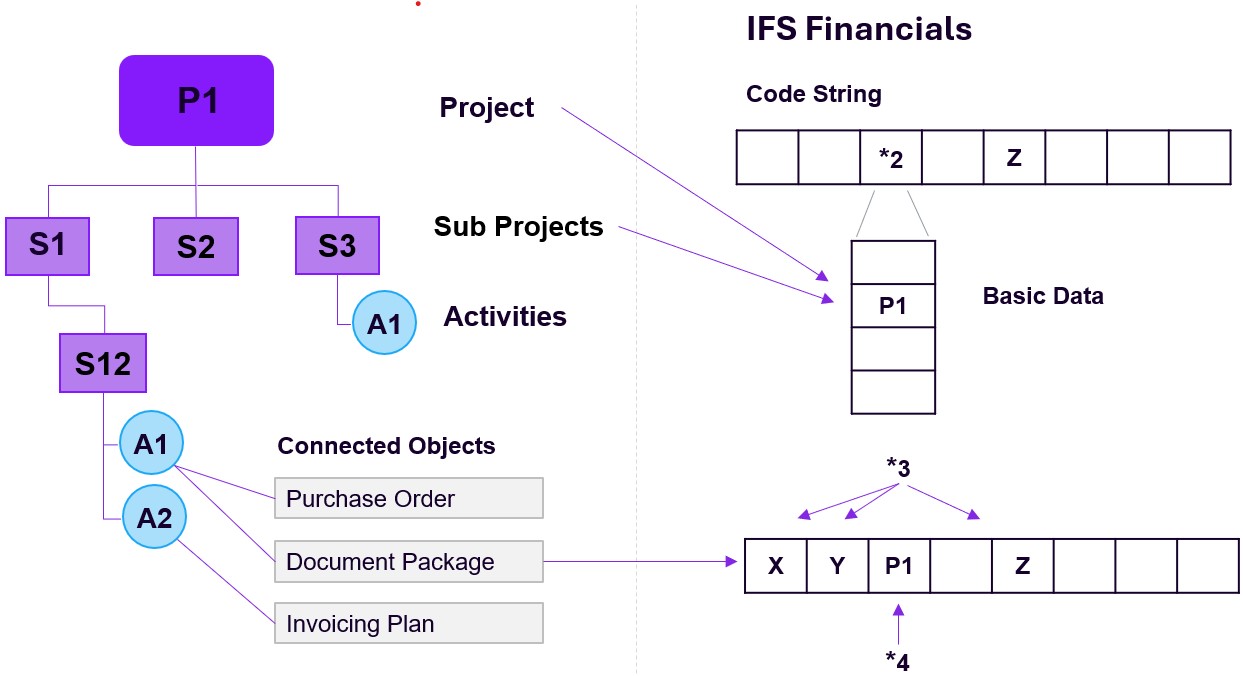
The diagram illustrates how pre-posting works in a project/sub project structure. Each project and sub project has its own code string definition (*2). When an object such as a Work Order, Document Package, or Purchase Order is connected to a project, the system inserts the first matching sub project’s code string. If no sub project match is found, the project’s code string (*2) is used instead. This value is then inserted into the appropriate position in the object’s code string (*4). Reference (*3) in the diagram shows this position, where the project value (for example, “P1”) becomes part of the overall posting structure.
In this example, the selected project dimension is Project, represented by dimension F. If you add another line on the Pre Postings tab in Project Setup for a sub project and specify a value for dimension G, the following pre-posting will be applied when a Purchase Order is created and connected to an activity belonging to that sub project:
| Code B | Code C .. Code E | Project | Code G | Code H .. Code J |
| M01 (Account) | Not used | P1 | 6 | Not used |
Explanation
- Project – The project dimension value (“P1”) defined in the pre-posting code string.
- Code G – A value defined in Accounting Rules, such as a department code (e.g., 1–10). In this example, the Purchase Order belongs to department 6.
- Account (Code B) – Determined by the posting type. Here, “M01” is the account defined for purchase orders.
The specific columns used for account, project dimension, and value dimensions are defined in Accounting Rules.
Workflow
- Defining: Pre-posting data is defined on the Pre Postings tab in Project Setup. All data entered, except for the project and sub project identifiers, can be changed later.
- Viewing: In Project Basic/Company Pre-posting, you can view a read-only list of the pre-posting data for all projects in the company.
- Modifying: Pre-posting information for a running project can be edited on the Pre Postings tab in Project Setup. Any changes made will affect the results in IFS Financials.
- Removing: Before removing a code string, ensure that the affected data in IFS Financials is obsolete and that the code string is not in use by an active project.