Travel Constraints
The following constraints are various ways in which travel may affect the allocation of activities.
Simple Travel Costs
All travel incurs costs - specified as a resource's cost per kilometre - and this will cause some activities to be preferred over others, simply because they are nearer to a resource, or a resource's route, than others. But if there is enough time to do all the work, this constraint alone should not prevent any activities being scheduled.
Maximum Travel
This is a constraint that a resource should not travel more than a certain distance from home. This travel limit is specified as the travel time required to return home. The constraint also applies to individual journeys within the route: if the maximum travel is one hour, then no journey within the route - activity to activity - may take more than one hour.
Warning
It is generally recommended that this constraint is not used: the Dynamic Scheduling Engine will in any case be trying to minimise travel, and setting a maximum travel can result in activities being unscheduled for no good reason. To avoid using the constraint, set the resource maximum travel to a large value, such as one day.
Travel Cost Models
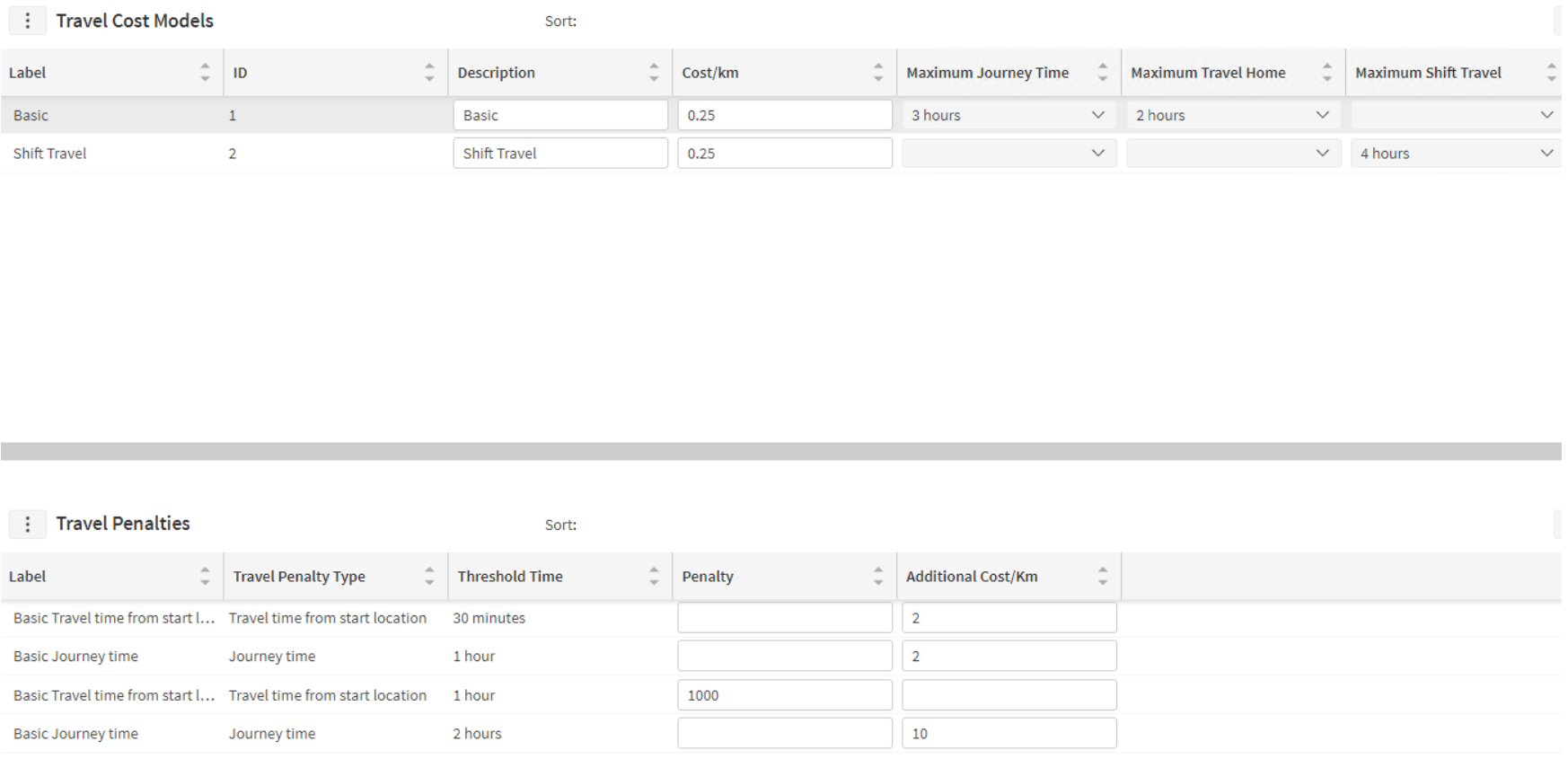
A Travel Cost Model gives more advanced options for restricting resource movements and journey times. This allows customers to apply any business rules they may have while still allowing the Dynamic Scheduling Engine to intelligently select when a longer journey is appropriate.
For example a customer may wish their resources to stay within a one hour radius of their base location, unless required to attend an urgent activity which would otherwise be significantly delayed.
The model supports three separate ways of penalising or restricting a resource's travel:
- Individual journey time.
- Journey time from base location.
- Total travel in shift.
There are also three options for applying penalties or restrictions:
- Hard maximum values.
- One off penalties.
- Incremental penalties.
Finally there is an option to reduce the cost of travel at the start or end of a resource's shift.
For further details, please see the section "Travel_Cost_Model" in the Scheduling Schema Guide