Machine Learning
Machine Learning covers how IFS Cloud connects to the IFS Machine Learning (ML) Service.
Note! Machine Learning in IFS Cloud is supported with both the Cloud Deployment Model and with the Remote Deployment Model. With the Cloud Deployment Model it is available out of the box. With the Remote Deployment Model it is used after connecting to the IFS.ai platform. Read more about Deployment Models and Connecting to AI Services.
Contents
- Trainable Model
- Trainable Models
- Pre-trained Model Tasks
- Large Language Model Tasks
- Time Series Forecasting Models
- Machine Learning Configurations
- ML Data Service Configuration
- Machine Learning Logs
About IFS Machine Learning Service
The IFS Machine Learning (ML) Service is a service on the multi-tenant IFS.ai platform. It provides the models used by IFS Cloud and integrates with third-party AI tools.
The ML Service supports four model types:
Trainable Models
A trainable model is trained on the customer's own data. Training uses classification or regression. After training, that data is not stored in the ML Service and is not accessible to another customer. The trained model can only be accessed by that customer.
For the administration page, see Trainable Models.
Pre-trained Model Tasks
Pre-trained models are provided by the ML Service so that a use case can run without training on the customer's own historical data. The models are embedded in the ML Service. Examples include Document Intelligence, which extracts, classifies, and interprets information from business documents. Customers do not need an Azure subscription.
For the administration page, see Pre-trained Model Tasks.
Large Language Model Tasks
IFS does not train its own large language models. The ML Service uses existing third-party large language models for generative AI. No customer data is used to train, re-train, or fine-tune those models.
LLM Task Use Case Categories
The ML Service supports these LLM tasks:
- Text-based entity extraction
- Summarization
- Content validation and enhancement
- Categorization
For the administration page, see Large Language Model Tasks.
IFS.ai Copilot
IFS.ai Copilot also uses large language models. It is separate from the Large Language Model Tasks listed above.
Time Series Forecasting Models
Time series forecasting models are provided by the ML Service for specific forecasting tasks. They are not trained on the customer's data. A forecast is generated from the time-series data supplied with the request.
For the administration page, see Time Series Forecasting Models.
How to Enable Machine Learning Service
Access requires an IFS.ai subscription and the relevant IFS Cloud components. With the Cloud Deployment Model, no further steps are required. With the Remote Deployment Model, connect the deployment to the IFS.ai platform. Read more about Connecting to AI Services.
How Does Machine Learning Service Operate
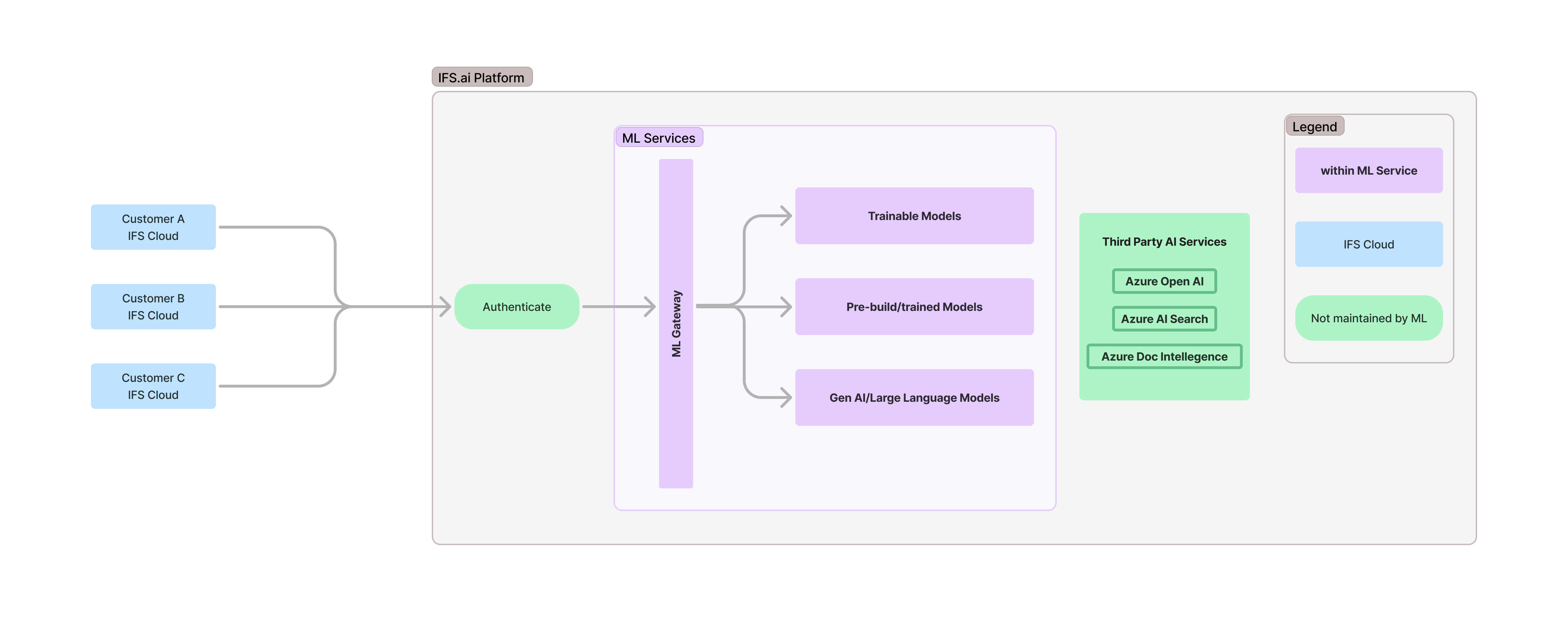
After the customer authenticates to the IFS.ai platform, requests reach the ML Service through the ML Gateway. The ML Gateway routes each request to the component that handles it. Request data is not kept after the request finishes. Data and models that the tenant keeps for training and retrieval are stored in that tenant's Azure Data Lake. Retrieval uses a tenant-specific Azure AI Search index.
ML Services Architecture
Training a Model
A training request is sent from the Trainable Models page in IFS Cloud to the ML Gateway. The ML Service fetches the customer data from that customer's IFS Cloud instance. The Tenant Information Service validates the tenant's entitlement to the use case. If the entitlement is valid, the data is used to train a model for that customer. Training status is shown on the Trainable Models page. The trained model is stored for that customer tenant and is not shared with other tenants. When the status is Trained, the training data is deleted from the ML Service. The customer data in IFS Cloud is unchanged.
How IFS.ai ML Service Is Secured
The platform uses a zero trust architecture.
- Requests are validated between components, including internal calls, using signed artifacts and authenticated API calls.
- Encryption in use includes AES-256 and TLS 1.3.
- The ML Service is penetration tested with every release.
- Artifacts in the software supply chain are validated for authenticity.
- Security policies are managed centrally and applied to the infrastructure and the services.
- The platform adheres to ISO 27001, SOC 1/2, and GDPR.
- The third-party Microsoft services adhere to ISO 27001, SOC 1/2/3, HIPAA, GDPR, Microsoft responsible AI principles, and FedRAMP (Federal Risk and Authorization Management Program).
The ML Service uses the following third-party Microsoft services.
| Third-Party Service | Policies |
|---|---|
| Azure Document Intelligence | - Data processed by Document Intelligence is deleted after processing. - Data in transit is encrypted with HTTPS/TLS. Data at rest is protected by Azure managed keys. - Microsoft does not use customer data to improve pre-built models. - Regional data residency is managed by IFS. |
| Azure OpenAI Service | - Data processed by the LLM models is deleted after the request completes. - Data in transit is encrypted with HTTPS/TLS. Data at rest is protected by Azure managed keys or by custom keys in Azure Key Vault. - Access is controlled with Azure Active Directory and role-based access control. - Data entered into the models is not used by Microsoft to improve or retrain the LLM. - The models are pre-trained on publicly available data and are not influenced by customer-specific inputs or outputs. - Regional data residency is managed by IFS. |
| Azure Maps | - Address lookup uses Azure Maps geocoding. - Azure Maps does not retain submitted address and geocoding data after the request. Geolocation data is not logged or stored after the operation. - Data in transit is encrypted with HTTPS/TLS. - Access is controlled with Azure Active Directory and role-based access control. - Microsoft does not use customer data or geolocation queries to train or improve Azure Maps. - Regional data residency is managed by IFS. |