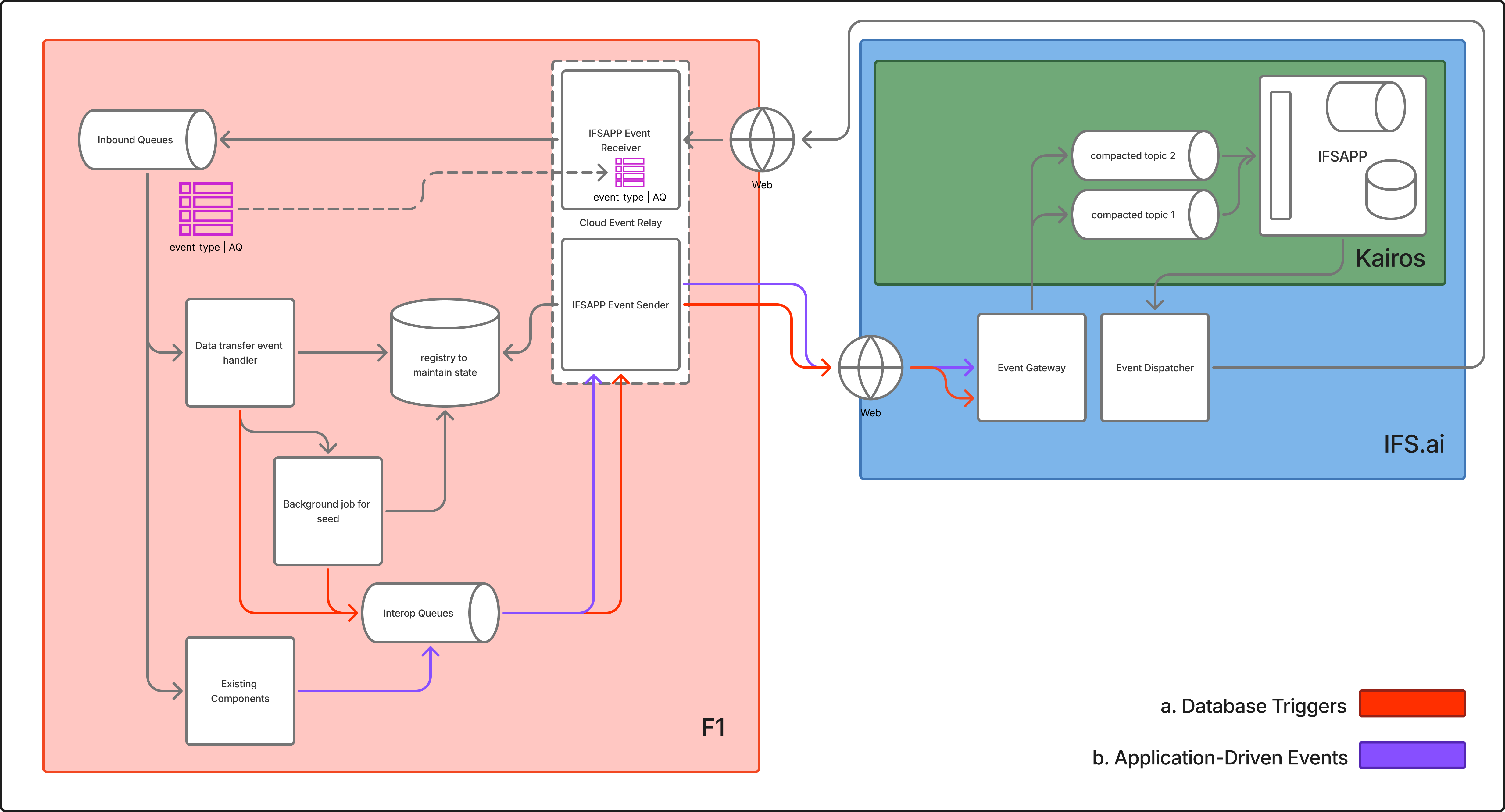
IFS Cloud Interoperability
The IFS Cloud Interoperability feature is designed to enable seamless, reliable data exchange between IFS Cloud and the IFS.ai platform. It supports both bringing data in (inbound) and sending data out (outbound) asynchronously, allowing IFS Cloud to operate as part of the broader IFS product ecosystem.
At its core, the feature uses standardized CloudEvents, modern integration patterns, and Oracle Advanced Queues (AQ) to ensure high reliability and traceability. This feature does not require a customer subscription to enable or customize anything. For the required IFS product capabilities, this feature will be automatically enabled. The sections below explain how this feature works under the hood.
Purpose of the Feature
As IFS continues to grow, the platform increasingly needs to interoperate across multiple components, making seamless communication between systems essential. IFS Cloud Interoperability ensures that:
- IFS.ai platform can push events or commands into IFS Cloud.
- IFS Cloud can publish changes or events to the IFS.ai platform.
- Integrations remain standardized, predictable, and scalable.
Inbound Integration (IFS.ai → IFS Cloud)
Inbound data handling is designed to be simple and structured.
How It Works
1. IFS.ai Invokes an Endpoint
The IFS.ai platform sends an event in CloudEvent format to an authenticated endpoint (routed internally through a proxy service).
2. CloudEventReceiver (Quarkus Service)
A lightweight Quarkus‑based service named CloudEventReceiver accepts the request. It performs:
- Basic validation (sanity checks)
- Registration checks to ensure the event type is supported
3. Message Enqueued to Oracle AQ
After validation, the message is placed into a designated Oracle Advanced Queue (AQ).
4. IFS Cloud Application Components Consume the Message
IFS Cloud components listen to and process messages from the queue. Once consumed, they can take any required action—update data, trigger business logic, run workflows, etc.
Outbound Integration (IFS Cloud → IFS.ai)
Outbound communication ensures IFS Cloud can communicate with the IFS.ai platform seamlessly for enabling extended capabilities.
Two Trigger Mechanisms
Outbound messages can be generated in two ways:
a. Database Triggers
When specific tables are updated, custom Oracle triggers can automatically write messages into an AQ.
b. Application-Driven Events
IFS Cloud components can programmatically push messages to the outbound AQ whenever a business event occurs.
CloudEventSender Service
A second containerized service—CloudEventSender—listens to outbound queues.
When a message appears:
- It reads the event from AQ.
- Transforms it into a CloudEvent structure.
- Sends it to the IFS.ai platform.
Summary